




If you use AI generated images in your Amazon listings, website, or ads, two new state laws just changed the rules, and Amazon has already started enforcing one of them. New York's disclosure law is in effect, and Amazon confirmed in late July that it's requiring sellers to label AI-generated people in listing images. California's law is coming this summer. Both carry real fines, and both apply even if your business isn't based in either state.
Here's what actually changed, who it applies to, and what you need to do to stay compliant while still using AI image tools to save money on product photography.
The Short Version
New York now requires a clear disclosure any time an advertisement uses an AI generated person, what the law calls a "synthetic performer." This took effect June 9, 2026. Fines start at $1,000 for a first violation and jump to $5,000 for each one after that.
California's AI Transparency Act (SB 942, amended by AB 853) takes a different approach. It mainly regulates the AI companies themselves, requiring watermarking and detection tools on generative AI image, video, and audio tools. It becomes operative August 2, 2026, and fines run up to $5,000 per day for a covered provider that's out of compliance.
Neither law cares where your business is headquartered. If your listings, ads, or product images reach shoppers in New York or California, you're in scope.
New York's Synthetic Performer Disclosure Law, Explained
New York Governor Kathy Hochul signed S.8420-A into law on December 11, 2025. The statute amends New York General Business Law Section 396-b and took effect June 9, 2026, 180 days after enactment.
The law requires a conspicuous disclosure whenever an advertisement includes a "synthetic performer," meaning a digitally created human that's meant to look real but isn't an identifiable person. This is squarely aimed at things sellers already do every day:
- AI generated lifestyle models "wearing" or "using" your product
- AI spokespeople or AI UGC style content
- Amazon main image and secondary image AI product images featuring a person
- AI generated hands, faces, or bodies added to a product shot
The disclosure obligation only kicks in if the advertiser has actual knowledge that the synthetic performer is in the ad, which matters most for brands relying on outside agencies or AI vendors. There's no set wording, size, or placement required, just that the disclosure has to be clear and hard to miss, similar to how the FTC expects influencer "#ad" disclosures to work.
What's exempt: audio only ads, ads for expressive works like movies, TV, and video games, and AI used purely for translating a real performer's speech. There's also a separate carve-out for real people: an AI-altered image of an actual, identifiable person isn't a "synthetic performer" under this law, that's covered instead by separate right-of-publicity and digital replica rules, including New York's Fashion Workers Act for AI replicas of models.
One detail sellers often miss: the law doesn't just cover the "hero" model in an image. A synthetic person in the background of a lifestyle shot, not just the main figure, still triggers the disclosure requirement.
Penalty: $1,000 for a first violation, $5,000 for each one after that. There's also a five day cure window in some cases if you get written notice and act quickly.
California's AI Transparency Act (SB 942 / AB 853)
California's law works differently than New York's. Instead of targeting every advertiser, SB 942 mainly puts obligations on "covered providers," meaning companies that build AI image, video, or audio tools with more than one million monthly users accessible in California.
Those providers have to offer a free public AI detection tool, let users add a visible AI label to generated content, and embed a hidden watermark with provenance data. If a licensee strips that watermark out, the provider has to cut off their access within 96 hours.
The original start date was January 1, 2026. AB 853 pushed it to August 2, 2026 to line up with the EU AI Act's transparency timeline, and it adds more rules for large platforms and AI hosting sites starting in 2027, and camera makers in 2028.
Penalty: $5,000 per violation, and under the statute each day a covered provider stays out of compliance counts as its own separate violation, so unresolved noncompliance adds up fast.
Sellers and marketers using tools like Midjourney or other big AI image generators won't be the ones fined directly under SB 942, that falls on the tool provider, but expect the tools you already use to start adding visible AI labels and watermarks automatically as they get ready for the deadline. Practically, that means your AI product images may soon carry a label whether you ask for one or not, so it's worth planning your listing design around that now instead of scrambling in August.
Do These Laws Apply to Images on Amazon?
Almost certainly, yes, if the imagery reaches New York shoppers, which basically means any national Amazon listing. This isn't just theoretical: Amazon's own Product Image Guide and A+ Content Guide now includes an official "AI-generated people disclosure" section confirming the requirement directly, following initial reporting from CNBC that Amazon had notified sellers of the policy change.
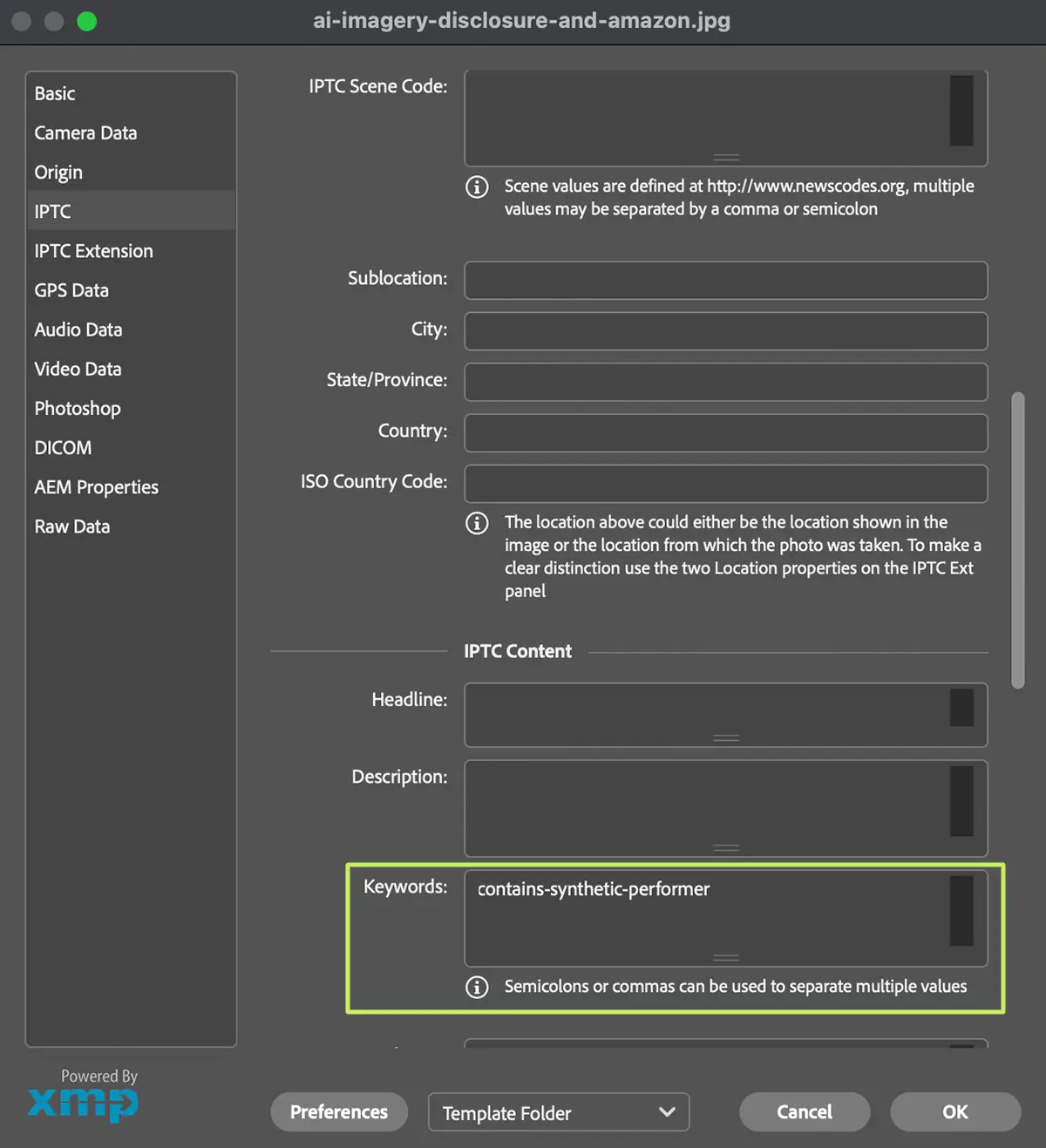
Per Amazon's own guidance, any image containing photorealistic AI-generated people must be tagged with the keyword contains-synthetic-performer before it's uploaded. The precise technical detail: this keyword needs to go in the dc:subject (XMP) field of the image file, added through an IPTC-compatible metadata editor. Amazon will then add a disclosure to the listing "where applicable" once that metadata is present, though the exact trigger criteria still aren't spelled out.
Two things Amazon explicitly carves out, straight from its own documentation:
- Real people edited with AI don't need the label, even if AI tools were used to alter their appearance.
- Fictional characters are exempt. Characters from movies, video games, or other expressive works, like poster art or box art, fall outside the requirement.
- Non-photorealistic AI people are exempt too. If the AI-generated person doesn't read as photorealistic, or the image has no people in it at all, no tag is needed.
Here's the practical read for AI images on Amazon product listings:
The line these laws draw is about photorealistic AI-generated people, not AI use in general. A question like "are ai-generated images allowed on Amazon product listings" comes up constantly in seller forums, and the honest answer is: Amazon's own Product Image Guide already allowed AI product images, and now it includes an official disclosure requirement layered on top specifically because of the New York law. You can still use AI product images on Amazon, but if that image shows a synthetic person, it now needs to be tagged before you upload it, on top of anything else state law requires.
Does an AI Label Hurt Conversion?
It's a fair question, and the honest answer is: probably, for some categories more than others. Research on AI disclosure labels has found that labeled AI content tends to draw lower trust and purchase intent than unlabeled content, with the gap widest on higher-consideration purchases. A $12 phone case probably won't see much of a dent. A $1,200 mattress or a big-ticket electronics purchase might.
That's a real reason to think about which images actually need a synthetic person in them versus which ones would work just as well with product-only shots, AI backgrounds behind a real, properly licensed model, or no AI figure at all. Hybrid production, a real model shot against an AI-generated background, currently sits outside the synthetic performer trigger entirely, which makes it a practical middle path for sellers who want the cost savings of AI without the label.
Amazon isn't acting in isolation here either. TikTok Shop and YouTube have both rolled out their own AI content labeling requirements over the past year, so sellers running the same creative across multiple channels should expect to tag it more than once, in slightly different ways, depending on the platform.
What to Expect When You Work With Me
AI imagery isn't going anywhere, it's simply entering a new phase where its use is being tracked and disclosed rather than left unregulated. Here's how I'm approaching that shift for every project going forward:
- I'm staying on top of these laws as they evolve — both New York's requirement and Amazon's response to it.
- I'll flag any AI-generated person in your creative, whether that's the main figure in a shot or someone in the background of a lifestyle scene.
- I'll add the
contains-synthetic-performerkeyword to thedc:subject(XMP) field of the image before delivery, so it's tagged and ready before it ever reaches your listing. - I'll add a visible on-image note as an extra layer, if you want it — a good option if you'd rather err on the side of caution while Amazon's guidance is still developing.
- I'll adjust my process as Amazon's guidance evolves, since some details, like exactly when Amazon's shopper-facing indicator gets triggered, still aren't fully spelled out.
My goal is simple: you get the cost and speed benefits AI imagery offers, without any surprises down the line.
One important note: I'll do my part to flag and tag AI-generated people in the creative I deliver, but the underlying compliance responsibility sits with you as the business owner. I'm not a lawyer, and I can't take on liability for how these laws apply to your specific listings or for any fines or penalties that result. I'd rather build good habits into my process now than have either of us caught off guard later, but please don't treat this as a substitute for your own legal or compliance review.
A Simple Compliance Checklist for Sellers
- Audit your live listings and ad creative. Pull every image and video that's currently running, on Amazon, your website, social, and email, and flag anything using AI generated people.
- Separate "people" images from "no people" images. Product-only AI shots, backgrounds, and infographics are lower risk. AI models and AI generated customers are the ones that need labels.
- Add a clear, visible disclosure. Something like "AI-generated image" or "Contains an AI-generated model" placed where a shopper will actually see it, not buried in fine print. On Amazon specifically, this now means applying the metadata tag Amazon requires on qualifying images and A+ content before you upload them, not just adding text to the description.
- Keep records. Log which tool created each image and when. If you ever get a compliance inquiry, you want a paper trail.
- Watch your AI tools for built-in labeling. As California's August 2 deadline approaches, expect image generation tools to start adding their own visible or hidden watermarks. Don't fight the label, design your listing images around it.
- Move tagging upstream. If you work with agencies, freelancers, or AI vendors for creative, build synthetic-figure disclosure into the delivery requirements and contract terms rather than trying to catch it after images land in your inbox.
- Set a recurring review. These laws are new and other states, including Illinois, Texas, Colorado, and Utah, are moving on similar bills. A quarterly check of your AI image practices will save you from playing catch up later.
Bottom Line
AI generated product images and AI ecommerce imagery aren't going away, they're too useful and too cheap compared to traditional photo shoots. What's changed is that showing an AI generated person in an ad or listing now comes with a real legal obligation in two of the biggest markets in the country. Label the people, keep records, and you can keep using AI image tools without the fines.
Sources
- New York General Business Law § 396-b (S.8420-A) — Skadden, Arps, Slate, Meagher & Flom LLP, effective June 9, 2026
- California Business and Professions Code § 22757 et seq. (SB 942 bill text) — California Legislative Information
- Two Newly Enacted New York Laws Will Regulate Certain AI-Generated Images — Skadden
- Understanding New York's Synthetic Performer Disclosure Law — Honigman
- Advertising Law Alert: New York Regulates AI-Generated and Posthumous Images — Cowan, Liebowitz & Latman
- California Enacts AI Transparency Law Requiring Disclosures for AI Content — Jones Day
- California AI Transparency Act Amendments Signed Into Law — Troutman Pepper
- Amazon Seller Central: Product Image Guide — Amazon, official source for the AI-generated people disclosure requirement
- Amazon makes sellers label AI-generated people in images after NY law — CNBC
- Amazon Requires Sellers To Label AI-Generated People In Listing Images — Forbes
- Amazon Requires Sellers to Disclose AI-Generated People in Product Images — eWeek